Tuesday, March 9, 2010

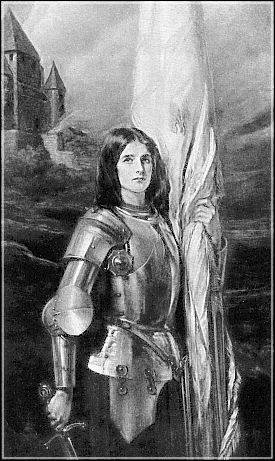
Women's History Profile: Joan of Arc


Joan of Arc was not a crusader for women’s rights or suffrage, those ideals had no standing in her day, but a warrior, fighting for her country by breaking gender roles of the time. 15th century France was a dark and dismal place marked with war, the after effects of the plague and royal feuding. The Hundred Years War was raging, and the English were continually gaining on the offensive. That was until a pheasant girl from a village became a commander in the army, leading France to a series of important victories.

Joan of Arc, born in 1412, had seen the effects of the war from a young age when her village was attacked and burned by opposing forces. At the age of 12, Joan heard her first voices. Throughout her life, Saints came to Joan relying messages from God. Although she would have been happy staying home and taking care of her mother, Joan was instructed by these voices to drive the English out of France and help Charles VII, the rightful heir, take the thrown. Inspired by God, Joan of Arc set off to have an interview at the royal court and help her country when she was 16.

Monday, March 8, 2010

Women's History Profile: Elizabeth Cady Stanton


Today, we go back a hundred and fifty years to take a look at one of the most famous women’s rights activists, Elizabeth Cady Stanton, Susan B. Anthony’s cohort in the suffrage movement of the 19th century. Although she is best known for her work with the women’s suffrage movement, her passion for women’s rights expanded beyond the scope of many of her peers including Susan B. Anthony. Born in 1815, Stanton was also thrust into the abolition movement until the passage of the 13th amendment in 1865.

What I find the most interesting about Stanton is how she became aware of sexual discrimination in the world and became impassioned to work against it. All of her male siblings had died, leaving her parents with four girls and no male heirs. At a young age, Stanton’s father, a prominent lawyer and politician told her, “Oh my daughter, I wish you were a boy.” This blatant preference of the male sex not only by her father but by society stirred a determination in Elizabeth from a young age to excel in the areas usually reserved to men and to be their equal. Her awareness of society’s prejudices and inequalities grew as her father taught her about the legal barriers between men and women. She also had her own personal experiences of discrimination including being denied admission to the Union college because she was female.

Friday, March 5, 2010

Women's History Month Profile: Nina Simone

Its funny to me that the only request we have gotten so far for Women’s History Month Profiles is for a musician. I feel like Casey Kasem.

So, this one goes out to our loyal reader Jodi!

Our feature today is, obviously, Nina Simone. I’m going to skip all of the early life information and go right to why she was way more then just a musician.


Nina Simone musically became influential in the early 1960’s. After a few years of teaching piano in Philadelphia, she quickly became popular by performing in Atlantic City bars and night clubs. From there, she was signed by a record label and recorded her breakthrough song “I loves you Porgy” in 1958. The song did extremely well and propelled Simone into musical popularity at the start of the new decade.
Nina Simone wrote songs that defined the times. Many of her recordings evoke singular moments during the civil rights movement and are historically important akin to the popular anti-war music of this era. For example, Simone wrote “Mississippi Goddam” in response to the bombing of a Baptist church in Alabama killed four children and the assassination of Medgar Evers. This and many other songs by Simone were adopted by the civil rights movement and encapsulated the thrust of emotion behind the social movements that were changing the landscape of the US.

Mississippi Goddam (sorry folks, the html link was broken)